Wood is the most democratic of the Yoruba artist’s materials. Bronze required imported metals, specialized foundries, and royal patronage. Ivory demanded access to the elephant trade and the sanction of the king. But wood was everywhere — in the forests of Ekiti and Ondo, the savanna woodlands of Oyo, the dense groves surrounding the sacred towns. And so it was in wood that the full range of Yoruba artistic imagination found its most varied and abundant expression: from the intimate scale of an ibeji twin figure small enough to cradle in one hand, to the monumental veranda posts that transformed a palace entrance into a narrative tableau taller than a man.
Yoruba woodcarving is not a single tradition but a constellation of related practices, each governed by its own conventions, its own patron deities, and its own networks of master-apprentice transmission. The carver (agbénà) occupied a respected position in Yoruba society, and the most accomplished carvers achieved a renown that transcended their immediate communities. Their works were commissioned by kings, chiefs, priests, and cult associations, and the best of them signed their pieces — not with written names, but with distinctive stylistic signatures that were as legible to the informed eye as any monogram.
Ifa Divination Boards & Bowls
At the center of Yoruba intellectual and spiritual life stands the Ifa divination system — an extraordinarily complex body of oral literature, philosophy, and ritual practice that has been recognized by UNESCO as a Masterpiece of the Oral and Intangible Heritage of Humanity. The material instruments of Ifa divination are among the most refined products of the Yoruba carver’s art.
- Source:
- The Metropolitan Museum of Art (MET)
- Culture:
- Yoruba peoples
- Date:
- 19th–20th century
- Medium:
- Wood, carved
- Function:
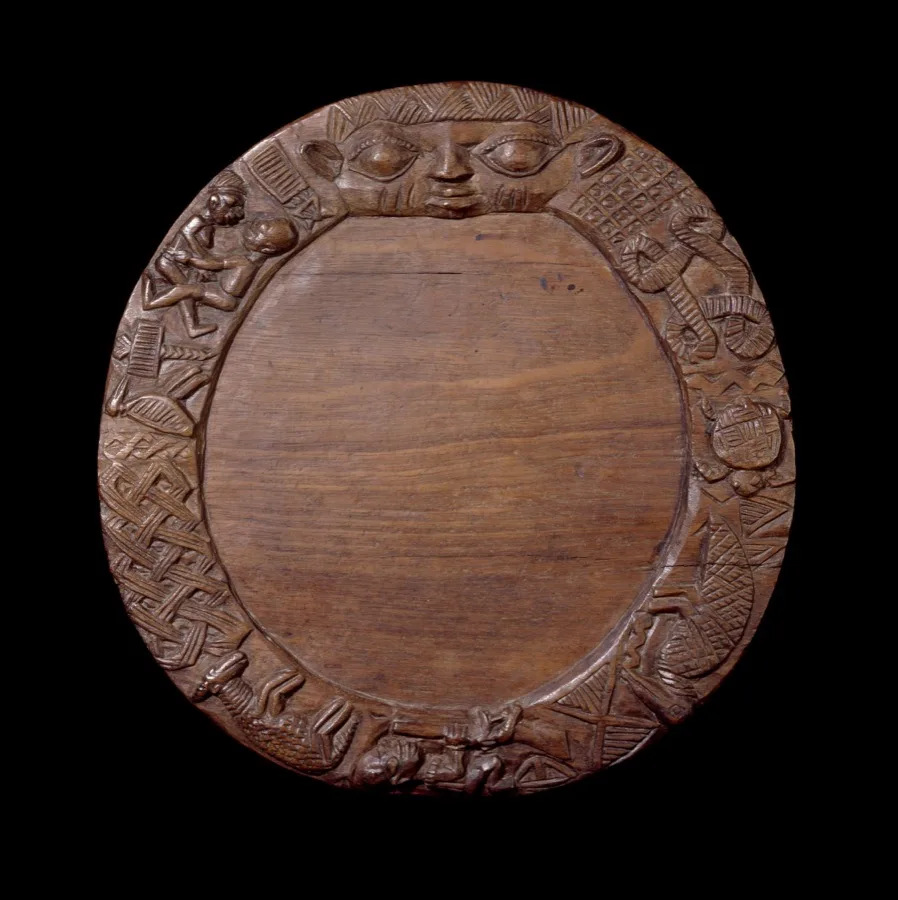
- Used by the babalawo (Ifa priest) to receive and interpret the signs of Ifa divination. Sacred palm-nut powder is spread on the flat surface, and the diviner traces the signature of the odu (verse) that has been cast.
The divination tray (opon Ifá) is a flat, usually circular or rectangular board with a raised border carved in relief. The flat central surface serves as the field on which the babalawo (Ifa priest) traces the marks of divination after casting the sacred palm nuts (ikin) or the divining chain (opele). The border is the carver’s canvas. It invariably features, at the top, a face representing Eshu — the trickster deity, the divine messenger, the guardian of the crossroads who mediates between the human and spiritual worlds. Around the rest of the border, the carver may depict scenes from the vast corpus of Ifa oral literature, images of daily life, representations of animals and spirits, or abstract geometric patterns of extraordinary intricacy.
The divination bowl (agere Ifá) — used to hold the sixteen sacred palm nuts when they are not in use — is typically supported by a carved caryatid figure or group of figures. These supporting figures are often masterpieces of small-scale sculpture: kneeling women, mounted warriors, mothers nursing children, drummers and dancers. The bowl becomes, in the hands of a skilled carver, a cosmological statement in miniature — a three-dimensional map of the forces and relationships that Ifa seeks to illuminate and harmonize.
Doors, Beams, and Veranda Posts
If the divination board represents the intimate, contemplative end of the Yoruba carving spectrum, the monumental architectural carvings — palace doors, roof beams, and veranda posts — represent its public, declamatory extreme. These works were commissioned by kings and powerful chiefs to adorn their compounds, and they served as permanent visual declarations of authority, wealth, and cultural knowledge.
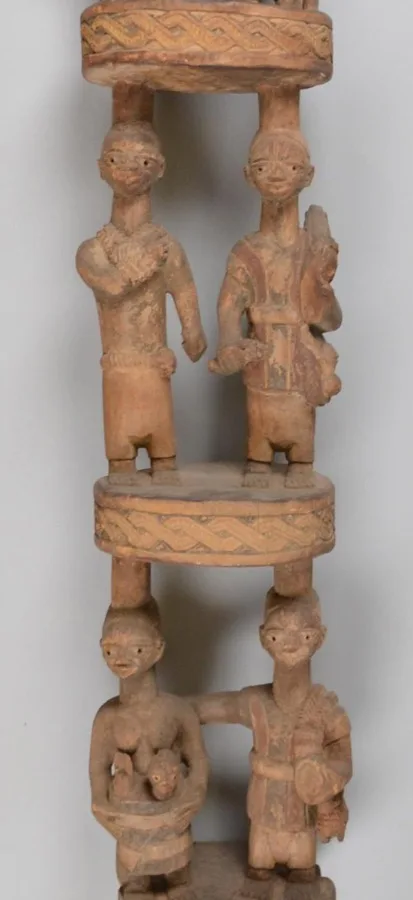
No carver embodies the monumental tradition more fully than Olowe of Ise (circa 1873–1938), who is widely regarded as the greatest Yoruba woodcarver of the modern era. Born in Efon-Alaaye but active primarily in Ise-Ekiti, Olowe received commissions from kings across Ekiti and beyond, and his work was collected during his lifetime by European visitors who recognized its extraordinary quality. His veranda posts for the palace of the Ogoga of Ikere — now in the collection of the Metropolitan Museum of Art — are among the masterpieces of world sculpture.
- Source:
- The Metropolitan Museum of Art (MET)
- Artist:
- Olowe of Ise (circa 1873–1938)
- Culture:
- Yoruba peoples, Ekiti
- Medium:
- Wood, pigment
- Significance:
- Olowe’s veranda posts are distinguished by their dynamic multi-figure compositions, dramatic sense of scale, and the virtuoso exploitation of the cylindrical tree-trunk form
What distinguishes Olowe’s work from that of other accomplished carvers is a combination of formal daring and narrative ambition. His figures are elongated and attenuated, creating a sense of upward thrust that defies the gravitational pull of the heavy roof they support. His compositions are genuinely three-dimensional: the figures project outward from the central column, turning, gesturing, interacting in space in a way that invites the viewer to move around the post and discover new relationships from every angle. And his subject matter draws on the full richness of Yoruba courtly life — enthroned kings, mounted warriors, women bearing offerings, musicians, diviners, and the ever-present birds that signal the spiritual dimension of royal authority.
The carved palace doors of Yorubaland are equally impressive in their ambition. Composed of multiple registers arranged vertically, they function as narrative panels — not unlike the bronze doors of European cathedrals, though the comparison does justice to neither tradition. The subject matter ranges from scenes of royal audience and military triumph to depictions of daily life, mythological episodes, and, in the colonial period, encounters with European missionaries and administrators. The door becomes a history book, a chronicle carved in wood that preserves the memory of events and the values of the community that commissioned it.
Masks — Epa and Gelede
Yoruba masking traditions are among the most visually spectacular and theatrically complex in Africa. Two traditions in particular — the Epa masquerade of the northeastern Yoruba (Ekiti, Igbomina) and the Gelede masquerade of the southwestern Yoruba (Egbado, Ketu, Anago) — have produced some of the most ambitious carved masks in the history of the art form.
- Culture:
- Yoruba peoples, Ekiti
- Date:
- 19th–20th century
- Medium:
- Wood, pigment
- Function:
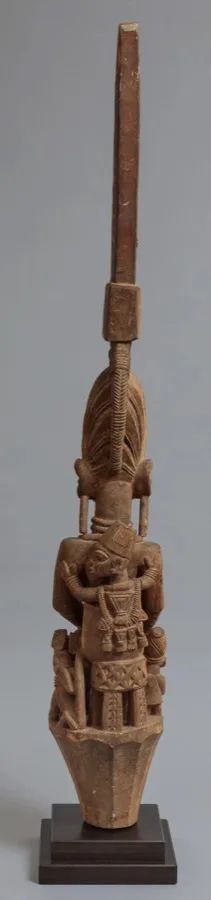
- Worn during the Epa festival, a multi-day celebration honouring cultural heroes, ancestors, and the forces that sustain community life
Epa masks are monumental constructions, sometimes weighing fifty pounds or more, consisting of a Janus-faced helmet base surmounted by an elaborate figurative superstructure. The superstructure may depict a mounted warrior, a mother surrounded by children, a master carver at work, or an enthroned king — each representing a different category of community benefactor. The dancer who wears the mask must be physically powerful enough to support its weight and agile enough to perform the acrobatic leaps that the masquerade requires. The festival itself is a celebration of the forces that sustain community life: martial valor, female fertility, artistic skill, and wise governance.
Gelede masks, by contrast, are worn on top of the head rather than over the face, and they tend toward a flatter, more graphic aesthetic. Their primary purpose is to honor and appease àwọn ìyá wa — “our mothers” — the spiritually powerful elder women whose benevolence ensures the well-being of the community and whose anger can bring catastrophe. The masks frequently depict scenes of daily life, satirical commentary on social behavior, and images of animals and supernatural beings. Their visual wit and social commentary make them among the most accessible and engaging of all African masking traditions.
Sango & Eshu Wands
The ritual wands associated with the worship of Sango (the thunder deity) and Eshu (the trickster messenger) represent a specialized but deeply significant branch of Yoruba woodcarving. The Sango staff (osè Sàngó) is the most recognizable: a carved wooden wand surmounted by the double-axe motif that is Sango’s primary symbol. The double axe represents the thunderstone (edun ara) — the neolithic celts that Yoruba tradition identifies as the projectiles hurled by the thunder god during storms.
The figural Sango wand typically depicts a kneeling female devotee holding the double axe on her head, an image that encodes the theology of Sango worship: the god’s power is received and carried by his devotees, predominantly women, who serve as vessels for his aṣe. The finest Sango wands achieve a remarkable synthesis of the devotional and the aesthetic: the kneeling figure is at once a statement of submission to divine power and a celebration of the human form in its most dignified posture.
Eshu figures and staffs are more varied in form, reflecting the protean nature of the deity they represent. Eshu is the guardian of the crossroads, the mediator between human beings and the other orisa (deities), and the embodiment of uncertainty, possibility, and the creative disruption that keeps the universe in motion. His carved images often feature a long, curved coiffure that projects backward from the head — a phallic motif that references Eshu’s association with potency, generation, and the unpredictable energies of creation. Many Eshu figures are studded with cowrie shells, the traditional Yoruba currency, acknowledging the deity’s role as the patron of markets and exchange.
Ibeji Twins
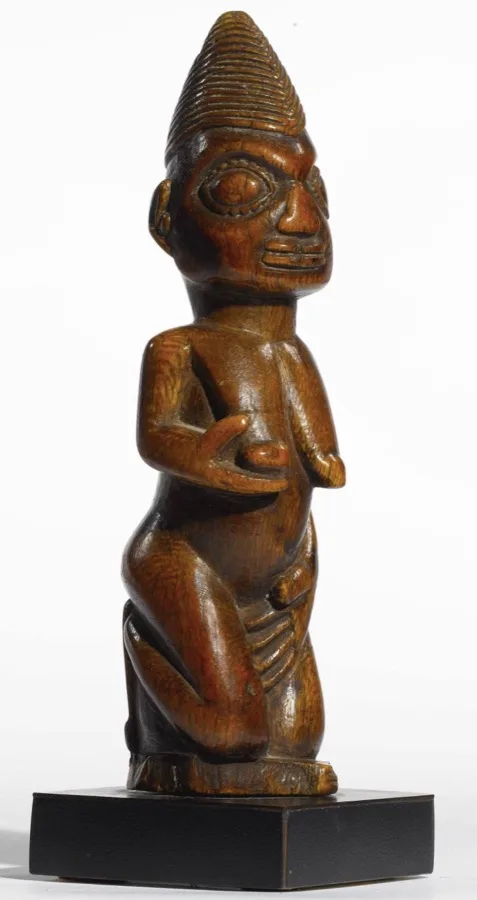
The Yoruba have the highest rate of twinning of any population in the world, and they have developed a uniquely elaborate cultural and spiritual response to this biological phenomenon. Twins (ibeji) are regarded as extraordinary beings, endowed with supernatural power that can bring either good fortune or calamity to their family. When a twin dies — and infant mortality was historically high — the family commissions a small carved figure (ere ibeji) to serve as a surrogate for the deceased child. The figure is then cared for as if it were a living child: washed, dressed, fed, anointed with oil and camwood powder, and carried by the mother or the surviving twin.
- Culture:
- Yoruba peoples
- Date:
- 19th–20th century
- Medium:
- Wood, beads, camwood powder (osun), indigo
- Function:
- Surrogate figures for deceased twins, cared for ritually to maintain the spiritual balance between the living and the dead twin
The ere ibeji is typically eight to twelve inches tall, depicting a standing adult figure rather than an infant — the child as it would have become, not as it was when it died. Regional styles vary considerably: Oyo figures tend toward smooth, rounded forms with minimal scarification; Igbomina figures feature more angular carving and prominent facial marks; Egba examples are often distinguished by their tall, elaborate coiffures. Over time, the surface of an ere ibeji acquires a deep, lustrous patina from the repeated application of camwood powder and palm oil — a patina that is itself a record of devotion, a visible accumulation of care layered over years and decades.
Tens of thousands of ere ibeji figures were produced across Yorubaland from at least the eighteenth century onward, making them one of the most abundant categories of Yoruba sculpture. Their sheer numbers have sometimes led to their undervaluation in the Western art market, but this abundance is itself significant: it testifies to the depth and persistence of the twin cult in Yoruba life, and it has provided scholars with a uniquely rich body of material for studying regional styles, workshop practices, and the relationship between artistic convention and individual expression in Yoruba art.
Contemporary Carvers & the Living Tradition
The history of Yoruba woodcarving does not end with the traditional forms. Throughout the twentieth century and into the twenty-first, artists have extended, reinvented, and transformed the carving tradition, negotiating between the demands of inherited convention and the possibilities of individual vision in a rapidly changing world.
Lamidi Onadipe Fakeye (1928–2009) was perhaps the most internationally celebrated Yoruba carver of the twentieth century. Born into a family of hereditary carvers in Ila Orangun, Fakeye trained in the traditional master-apprentice system before studying with the French artist Father Kevin Carroll, who was himself working to sustain and document Yoruba carving traditions. Fakeye’s career spanned six decades, during which he produced works ranging from traditional veranda posts and doors to monumental commissions for churches, universities, and government buildings. His style, rooted in the Ekiti carving tradition, was distinguished by its fluency, its narrative richness, and its ability to move seamlessly between traditional and contemporary subjects. He taught at several American universities and exhibited worldwide, becoming an ambassador for Yoruba art in the broadest sense.
- Artist:
- Lamidi Onadipe Fakeye (1928–2009)
- Culture:
- Yoruba peoples
- Medium:
- Wood, carved
- Significance:
- One of the most important Yoruba carvers of the 20th century, Fakeye trained in the hereditary tradition and carried it into global prominence through exhibitions, teaching, and monumental commissions
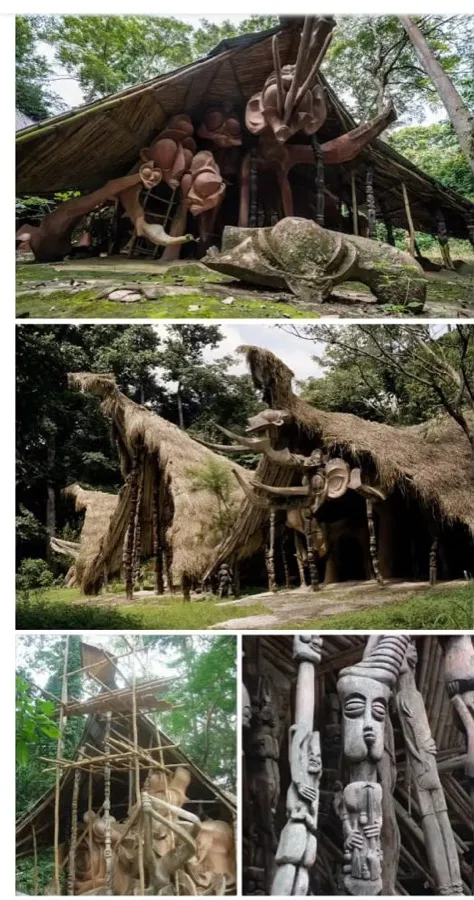
Susanne Wenger (1915–2009), an Austrian-born artist who settled permanently in Osogbo, Nigeria, in the 1950s, represents a different but equally significant strand of the living tradition. Wenger, who was initiated into the worship of the river goddess Osun and took the Yoruba name Adunni Olorisa, devoted her life to the restoration and artistic elaboration of the Osun-Osogbo Sacred Grove. Working with local Yoruba artists — including the carver Adebisi Akanji and the painter Twins Seven-Seven — Wenger created a body of monumental sculpture and architectural work that fused Yoruba spiritual iconography with an expressionist aesthetic vocabulary. The Sacred Grove, now a UNESCO World Heritage Site, stands as a testament to the creative possibilities that emerge when traditions are not merely preserved but actively reimagined.
Yusuf Adebayo Cameron Grillo (1934–2021), though primarily known as a painter, belongs to this conversation as one of the pioneers of modern Nigerian art who drew deeply on Yoruba visual traditions. Trained at the Yaba College of Technology in Lagos and later at the Camberwell School of Art in London, Grillo developed a distinctive style that married European modernist techniques — particularly the flattened forms and bold outlines of post-Cubist painting — with the iconographic vocabulary and colour sensibilities of Yoruba art. His depictions of Yoruba women, masquerade figures, and ceremonial scenes achieved a synthesis that was neither imitative nor merely decorative, but genuinely new: a visual language adequate to the experience of being Yoruba in the modern world.
These artists, and the many others who work in their wake, demonstrate that Yoruba woodcarving — and Yoruba visual culture more broadly — is not a closed chapter in art history but an ongoing conversation. The tools may change, the patrons may change, the contexts of display and reception may be transformed beyond recognition. But the fundamental impulse remains: to give visible, tangible, enduring form to the forces, relationships, and mysteries that define human life in all its complexity. That impulse, first expressed in the ancient carvings of Ife and elaborated through centuries of unbroken tradition, shows no sign of exhaustion. It is, if anything, gathering strength.
Comments