Cloth, in Yoruba culture, is never merely cloth. It is a language of status, a vehicle of spiritual power, a repository of history, and an index of the wearer’s place in the intricate social hierarchies that govern Yoruba life. From the prestigious aso olona of Ijebu weavers to the indigo-steeped adire cloths of Abeokuta, from the narrow-strip aso ofi woven on men’s looms across Yorubaland to the beaded crowns and robes that constitute the sacred regalia of Yoruba kings, textile production represents one of the most sustained and sophisticated artistic traditions in the history of West Africa.
The antiquity of Yoruba textile traditions is difficult to establish with precision, since cloth — unlike bronze or terracotta — seldom survives the centuries. But the evidence, both archaeological and literary, points to a deep history. Spindle whorls recovered from archaeological sites at Ile-Ife and Old Oyo suggest that cotton spinning was well established by the eleventh or twelfth century. Portuguese visitors to the Benin kingdom in the late fifteenth century noted the fine cloths worn by the court, many of which were imported from Yoruba regions to the west. And Yoruba oral traditions consistently associate specific weaving techniques with the deep past, linking them to the founding myths of particular towns and lineages.
Aso Olona — The Prestigious Cloth of Ijebu
Among the most revered of all Yoruba textiles is aso olona, literally “cloth of the wealthy” or “cloth that has an owner.” Produced in the Ijebu region of southwestern Yorubaland, aso olona is a prestige cloth of extraordinary complexity, woven on the narrow-strip loom but distinguished by its intricate supplementary-weft patterns, its dense construction, and the sheer number of strips required to compose a single wrapper. A full aso olona garment might incorporate twenty or more narrow strips, each bearing its own pattern vocabulary, sewn edge to edge to create a cloth of commanding visual density.
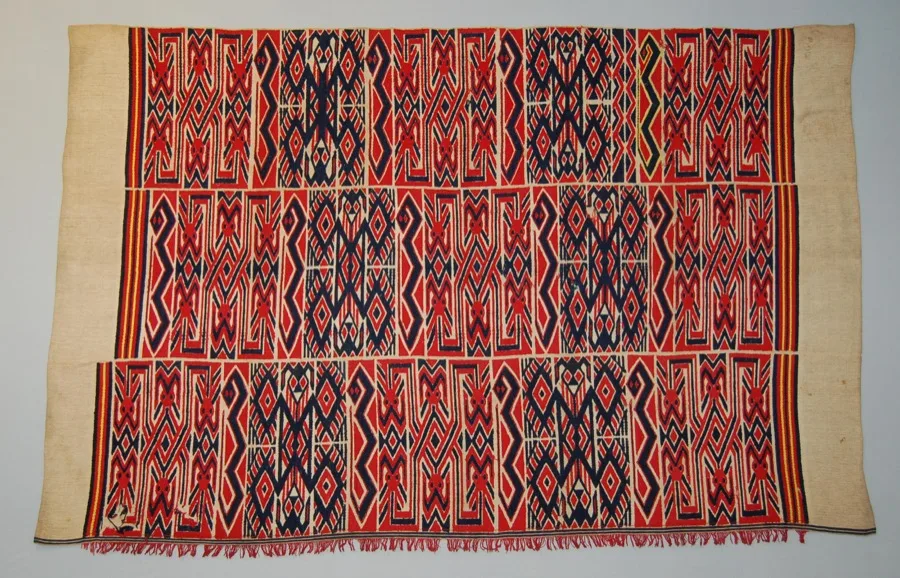
- Culture:
- Yoruba peoples, Ijebu
- Medium:
- Cotton and silk, narrow-strip loom weaving with supplementary-weft patterns
- Significance:
- Among the most technically complex and prestigious cloths produced in Yorubaland, reserved for high-ranking chiefs and ceremonial occasions
The production of aso olona was traditionally the province of male weavers, organized into guilds that controlled access to the most complex patterns and techniques. The knowledge of specific designs was proprietary, passed from master to apprentice within lineage-based workshops. Certain patterns were reserved for particular ranks of chief or for specific ceremonial occasions, so that the cloth itself functioned as a readable text, communicating the wearer’s status to anyone literate in the visual language of Ijebu society.
The materials themselves carried meaning. The finest aso olona incorporated imported silk, unravelled from European trade goods and rewoven into the local textile vocabulary. This practice — the creative appropriation of imported materials into indigenous aesthetic systems — is a recurrent theme in Yoruba textile history, and it speaks to the dynamism and adaptability of Yoruba artistic culture. Far from being a sign of dependence on foreign goods, the use of imported silk in aso olona represented a sovereign aesthetic choice: the Ijebu weavers took what they wanted from the global marketplace and transformed it into something unmistakably their own.
Aso Ofi / Aso Oke — The Narrow-Strip Loom Tradition
Aso ofi — also widely known as aso oke, literally “cloth from up-country” — is the foundational textile tradition of the Yoruba peoples. Woven on the narrow-strip horizontal loom operated by men, aso ofi is produced in long strips typically four to six inches wide, which are then cut and sewn together edge to edge to create cloths of the desired width. The technique is shared across West Africa, from the Mande peoples of Mali and Guinea to the Ewe and Ashanti of Ghana, but the Yoruba have developed it into one of its most sophisticated expressions.
Three principal types of aso oke define the tradition. Sanyan, woven from the pale brown silk of the Anaphe moth, is the most prestigious and the most ancient. Its soft, muted tones — ranging from beige to a warm caramel — carry associations of antiquity, wealth, and understated elegance. Alaari, characterized by its deep red or magenta colour achieved through the use of imported silk or aniline dyes, is the cloth of ceremony and celebration, worn at weddings, installations, and festivals. Etu, a dark indigo cloth with a restrained palette, is associated with dignity, maturity, and social gravitas.
The production of aso oke has historically been centred in the towns of the Oyo and Osun regions — Iseyin, Oyo, Ilesa, Ede, and their surrounding villages. In these communities, weaving was (and in many cases remains) a hereditary occupation, with entire compounds devoted to the craft. The rhythmic clatter of the loom — the shuttle thrown, the heddles raised and lowered, the beater pressed against the weft — was the ambient sound of daily life, as pervasive and unremarkable as birdsong.
In the twentieth century, aso oke underwent a remarkable transformation. The introduction of lurex (metallic) threads, synthetic dyes, and new pattern vocabularies expanded the aesthetic range of the tradition without destroying its essential character. Today, aso oke remains central to Yoruba ceremonial life. At weddings, entire families commission matching fabrics — the aso ebi or “family cloth” — from aso oke weavers, creating a visual solidarity that is both beautiful and socially meaningful.
Adire — The Indigo-Dyed Resist Cloths
Adire — the Yoruba term for cloth decorated through various resist-dyeing techniques using indigo — represents one of the most visually striking and technically inventive textile traditions in Africa. Unlike aso ofi, which achieves its patterning through the structure of the weave itself, adire begins with plain white cotton cloth (originally handwoven, later imported) and creates its designs through the selective prevention of dye penetration.
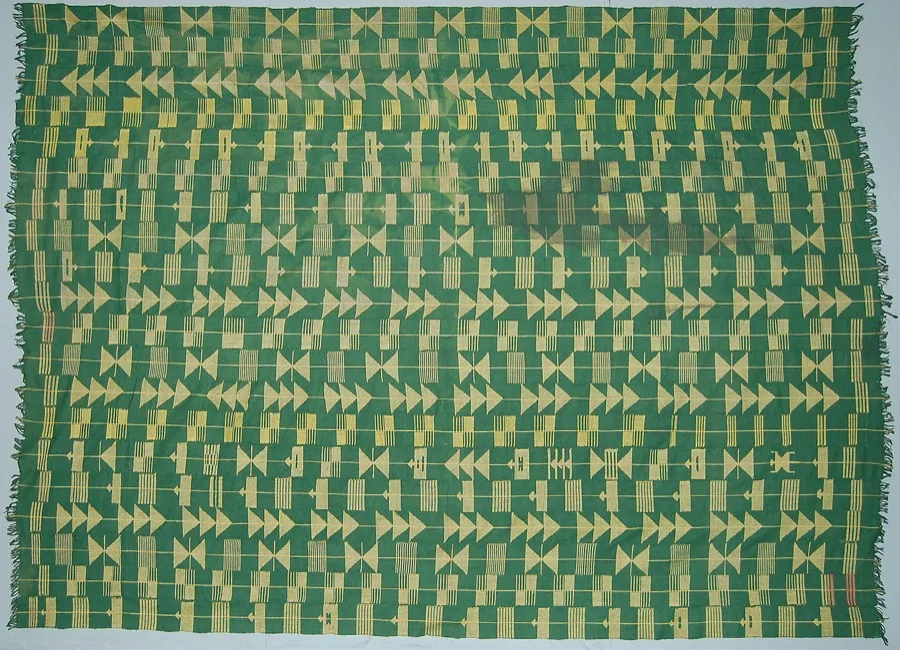
- Culture:
- Yoruba peoples, Egba (Abeokuta)
- Medium:
- Cotton, indigo dye, cassava-starch resist
- Technique:
- Adire eleko — designs painted or stencilled onto cloth using cassava starch paste before immersion in indigo dye vat
Two principal techniques define the adire tradition. Adire oniko employs tied-resist methods: sections of cloth are gathered, bound tightly with raffia or thread, and then dipped in indigo. The bound areas resist the dye, producing patterns of white against blue when the bindings are removed. The technique yields bold, graphic designs — concentric circles, radiating starbursts, rhythmic grids — that exploit the tension between controlled intention and the beautiful unpredictability of the resist process.
Adire eleko, the more pictorially complex technique, uses cassava starch (eko) as the resist medium. The starch paste is painted onto the cloth freehand or applied through metal stencils cut from the zinc linings of tea chests — another instance of the Yoruba genius for creative appropriation of imported materials. The designs achievable through adire eleko are extraordinarily varied: they include figurative motifs (birds, combs, keys, bicycles, crowns), geometric patterns, and inscriptions in Yoruba. Many of these designs bear specific names and carry specific meanings, so that a cloth’s pattern vocabulary constitutes a form of visual communication.
The city of Abeokuta, capital of the Egba Yoruba, became the undisputed center of adire production in the late nineteenth and early twentieth centuries. The industry was dominated by women, who controlled every stage of the process from the preparation of the indigo vat to the marketing of the finished cloth. The great adire markets of Abeokuta — particularly Kenta market — attracted buyers from across West Africa and beyond, and the cloth became one of the most recognizable products of Yoruba material culture.
Beaded Crowns & Robes — The Sacred Regalia of Kings
If aso ofi and adire represent the textile arts of the broader Yoruba populace, the beaded crowns and robes of Yoruba kings (oba) represent the summit of the textile hierarchy — garments so charged with spiritual power that they are as much ritual objects as articles of clothing. The beaded crown (adé) is the single most important symbol of Yoruba kingship, and its imagery encodes the theological and political foundations of royal authority.
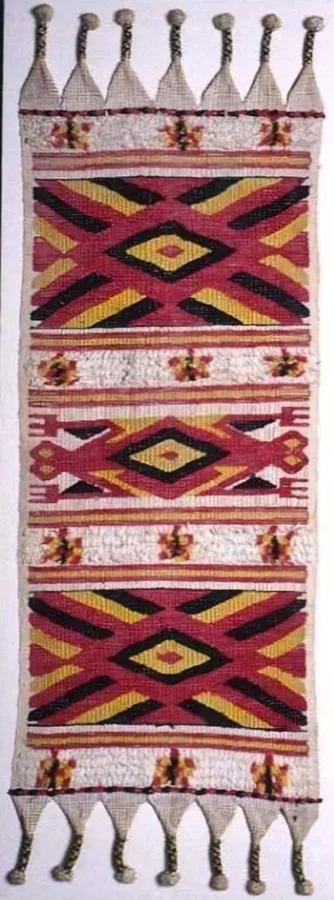
- Source:
- The Metropolitan Museum of Art (MET)
- Culture:
- Yoruba peoples
- Date:
- 19th–20th century
- Medium:
- Glass beads, cloth, iron
- Significance:
- The beaded crown is the paramount symbol of Yoruba kingship, worn only by rulers who can trace their descent from Oduduwa, the mythical founder of Ile-Ife
The most prominent motif on the beaded crown is the bird. Virtually every Yoruba royal crown features one or more birds, usually perched on the summit or arrayed around the upper register. These birds are not merely decorative. They reference àjé — the mystical power associated with elderly women, often called “the mothers” (ìyá mi) or “the owners of the bird” (eléiyé). In Yoruba cosmology, this feminine spiritual power is both essential and dangerous: it can nurture or destroy, protect or punish. The birds on the crown acknowledge that the king’s authority depends, in part, on the acquiescence of these powerful women. The crown thus encodes a political theology in which male royal authority is sustained by, and answerable to, a deeper feminine spiritual force.
The beaded veil (iboju) that hangs from the front of the crown, concealing the king’s face, serves a further ritual function: it transforms the wearer from a mortal individual into the embodiment of the dynasty. Behind the veil, the king’s personal identity dissolves; what remains is the office, the lineage, the accumulated aṣe (spiritual power) of all his predecessors. The crown, in this sense, is not worn so much as inhabited.
Beaded robes, footwear, staffs, and flywhisks complete the royal ensemble. The beadwork tradition, like weaving, was organized through specialized guilds, and the knowledge of crown-making was among the most closely guarded secrets in Yoruba artistic culture. The beads themselves — originally stone or coral, later glass beads imported from Venice and Bohemia — were precious commodities, and their accumulation on the royal person was itself a statement of wealth and the reach of the kingdom’s trade networks.
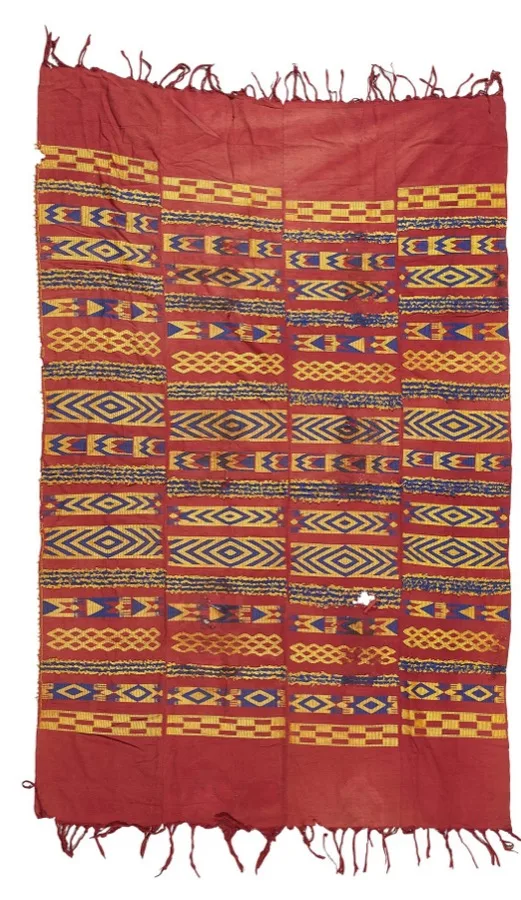
- Culture:
- Yoruba peoples
- Medium:
- Glass beads, cloth, leather
- Significance:
- The complete beaded ensemble transforms the king from a mortal individual into the living embodiment of the royal dynasty and its accumulated spiritual authority
Taken together, these textile traditions — from the communal aso oke of weddings and festivals to the sacred isolation of the beaded crown — constitute a visual culture of remarkable depth and coherence. They demonstrate that for the Yoruba, cloth is never inert material. It is a technology of identity, a medium of spiritual communication, and one of the most eloquent expressions of a civilization that has always understood that what covers the body also reveals the soul.
Comments